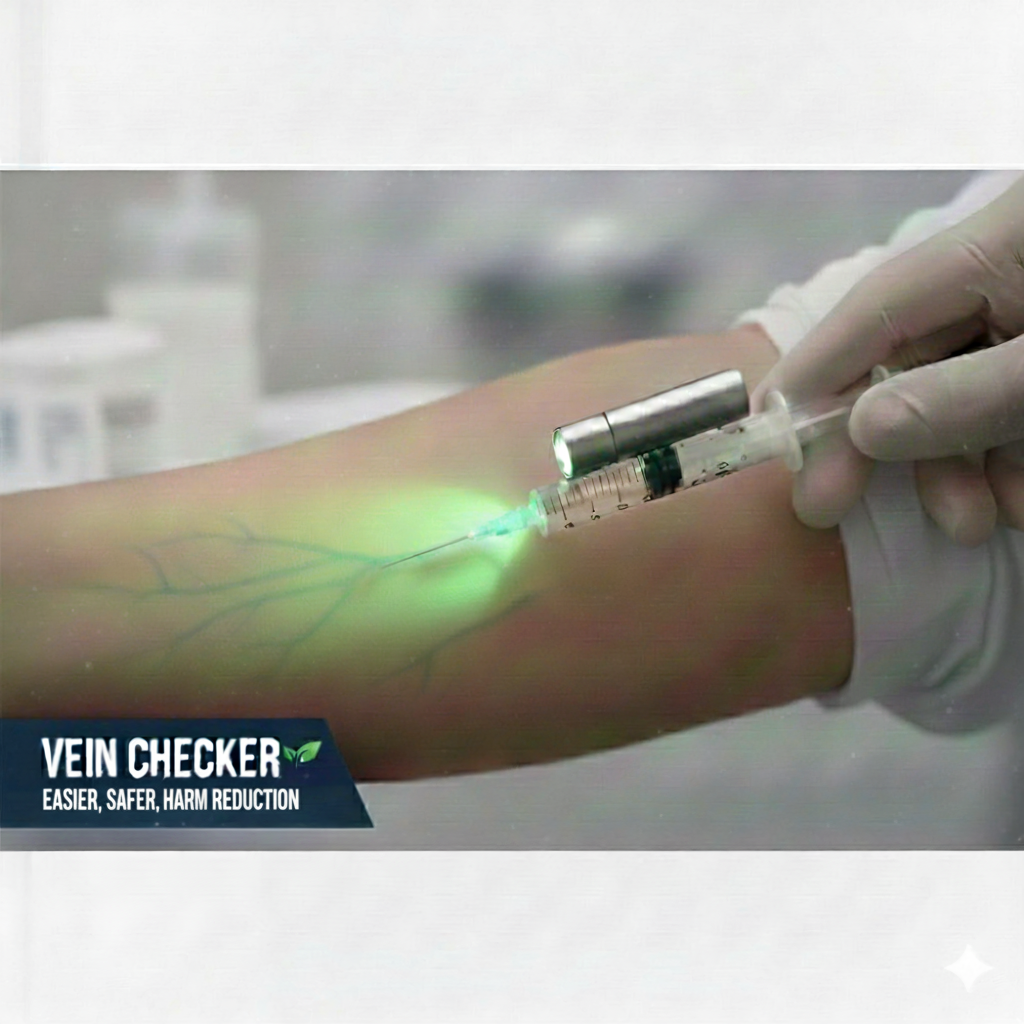
VeinChecker
1. Plain English Summary
2. Background and Unmet Need
Individuals presenting with severe peripheral vascular degradation or deep scarring experience extreme difficulties with venous access. In community-based harm reduction environments, low ambient light or high-stress contexts regularly compound this issue, turning standard procedures into prolonged, recursive attempts. Without direct, immediate guidance, operators and service users often resort to blind tracking, which significantly escalates the risk of deep-tissue abscesses, accidental arterial access, severe vein collapse, and localized bacterial contamination.
Existing commercial vein finders are bulkier, standalone hand-held or desktop units that cost thousands of pounds. They require an assistant to hold the light source or force the operator to abandon standard single-handed stabilization techniques. There is a profound public health need for a tiny, clip-on transilluminator that moves in perfect unison with the syringe assembly, allowing standard single-handed workflows to be maintained.
3. Research Question
4. Work Packages
WP1 – Optical Array Tuning & Clip Tolerance Lock
Optimization of the solid-state emitter wavelength array to achieve maximum contrast differentials against skin tissue while ensuring strict mechanical tension fits across standard syringe barrels.

WP2 – Human Factors & Ergonomic Tracking Stability
Simulated bench validation evaluating physical weight balance shifts, activation switch accessibility, and line-of-sight tracking consistency during simulated recursive insertion sequences.
WP3 – Battery Discharge & Thermal Performance Safety
Rigorous environmental stress-testing focusing on continuous light output thermal limits, battery lifecycle safety, and standard disinfection protocol tolerances.
WP4 – Frontline Field Feasibility Evaluation
Observational human factors data collection with mobile nursing teams and outreach workers to gauge real-world workflow integration constraints.
5. Cost Breakdown (Indicative NIHR Feasibility Budget)
| Category | Description | Estimated Cost (£) |
|---|---|---|
| Prototype Development | Materials, custom optoelectronic fabrication, enclosure iteration | £3,000 |
| Human Factors Testing | Simulation lab scheduling, stakeholder usability assessments | £5,000 |
| PPIE Engagement | Service user focus groups, feedback honorariums, and compensation | £2,000 |
| Regulatory & Safety Review | Preliminary compliance identification and UKCA pre-classification metrics | £2,500 |
| Project Management | Administrative coordination, milestone auditing, technical reporting | £3,500 |
| Total Estimated Budget | £16,000 | |
6. Outcome Measures
- Immediate visual clarity of underlying vascular pathways under variable room lighting conditions
- Zero physical displacement or rotation of the module during high-pressure syringe plunging
- Quantifiable reduction in time-to-localization during simulated difficult access setups
- High user acceptance ratings scored via standardized System Usability Scales (SUS)
7. Equality, Diversity & Inclusion
This development project is strategically directed toward mitigating deep systemic health inequalities within deeply marginalized regional communities. By involving peer-led validation teams and frontline harm reduction networks early, the device configuration ensures effective, intuitive utility across historically under-represented populations.
8. Risk Register
Chief Investigator / Applicant
Mark Gomersall
markgomersall2@gmail.com